
If you’ve started looking into having a new kitchen fitted, you’ve probably already come across a whole collection of terms that sound as though they mean much the same thing: bespoke, made to measure, handmade, custom.
The trouble is these terms aren’t necessarily interchangeable. A kitchen described as ‘made to measure’ can be very different from a bespoke kitchen, while a handmade kitchen isn’t automatically bespoke either.
This difference can affect how your kitchen is designed, what materials are used, how much flexibility you have over the details and, ultimately, how much you pay.
Here’s a clear look at the three main routes, what you get with each, and how to work out which one is right for your home.
High street kitchens
High street kitchens are built around standard cabinet sizes, usually in fixed increments. You choose from a set range of door styles, colours and handles, and the design is assembled from those components. Where the units don’t quite reach a wall or a ceiling, filler panels close the gap. End panels tend to be standard sizes too, which doesn’t allow for scribing if your walls are not flat.
Almost everything is mass-produced or bought in, which helps keep prices down and lead times short. For a straightforward rectangular room in a newer property, particularly if you’re updating a house you don’t plan to stay in long-term, this can be a sensible choice.
The limitations are more noticeable when you have an awkward room or want more flexibility. Door materials are usually MDF with a sprayed, foil or laminate finish, so they’re more vulnerable to moisture and knocks over time. Internal storage options are generally limited to what the range offers. And if your room has a chimney breast, sloping ceiling or a run that falls awkwardly between two sizes, the solution is to fill the gaps instead of altering the cabinetry itself.
Made to measure kitchens
Made to measure sits somewhere in the middle, and it’s the category where definitions vary most between companies.
Typically, you’re still starting from an existing range, but elements of it are adjusted to fit your room. That might mean cabinets altered in width, height or depth, end panels scribed to an uneven wall, or doors made to a non-standard size. Made-to-measure pieces fit awkward spaces much more neatly than a purely modular kitchen, and you’ll usually have more choice over finishes.
This is where it helps to know exactly what ‘made to measure’ means. The term can cover anything from one reduced-width cabinet in an otherwise standard run to a heavily adapted design. Ask which parts would be made specifically for your room and which are coming from an existing range.
Bespoke kitchens
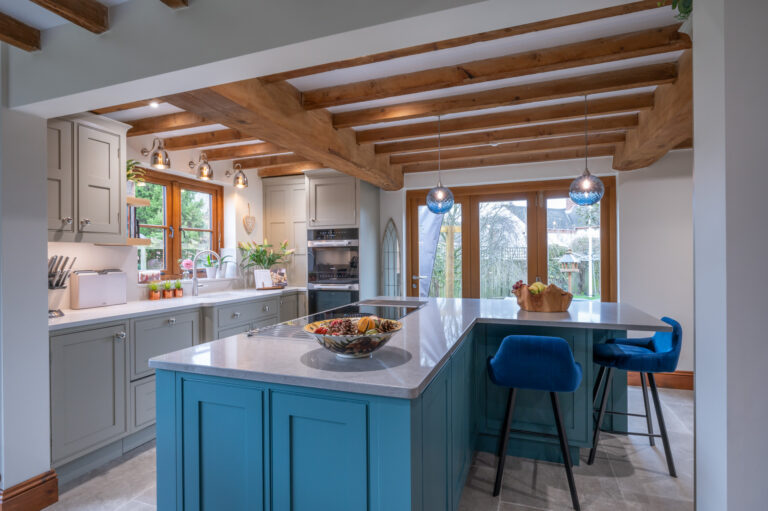
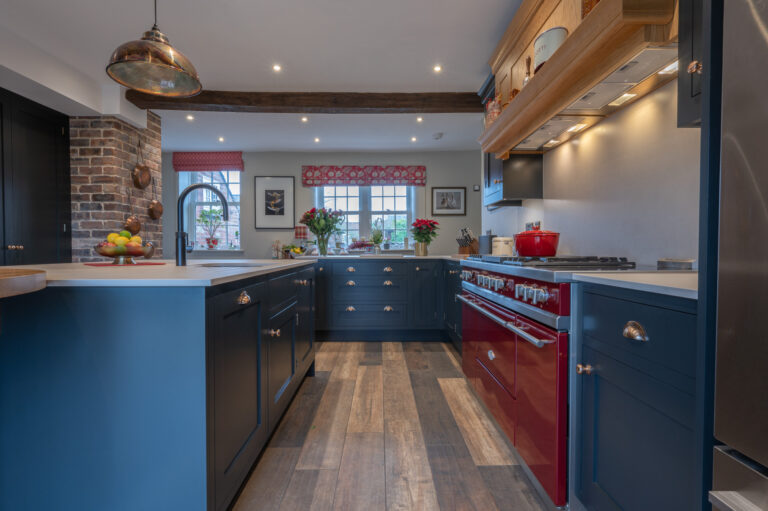
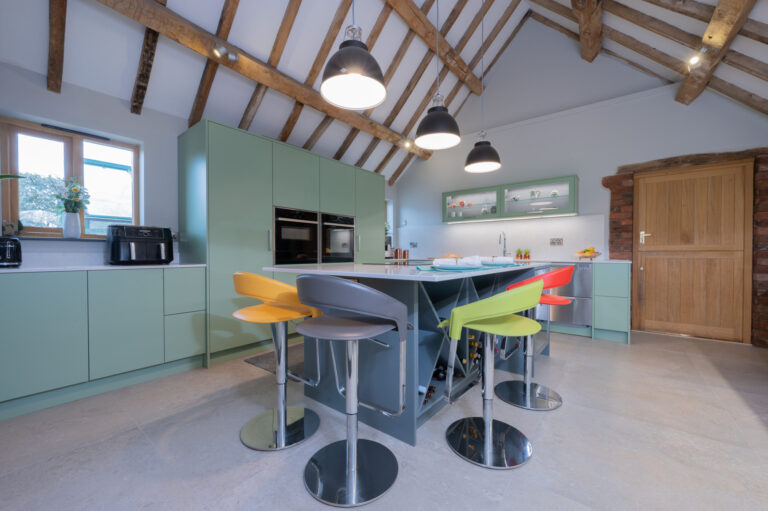
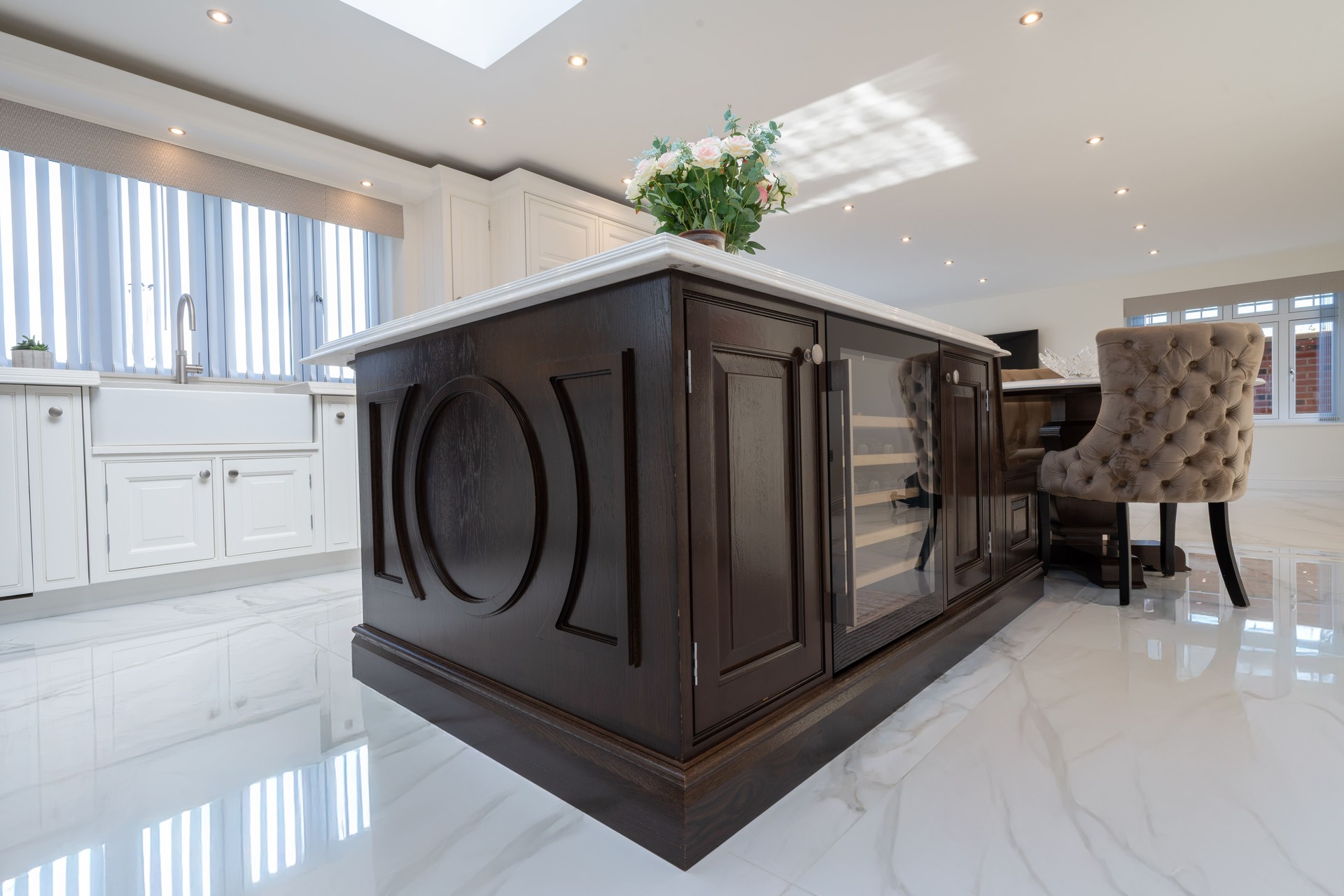
A truly bespoke kitchen doesn’t start with a range at all. It starts with your home and the way you want the finished space to feel and function.
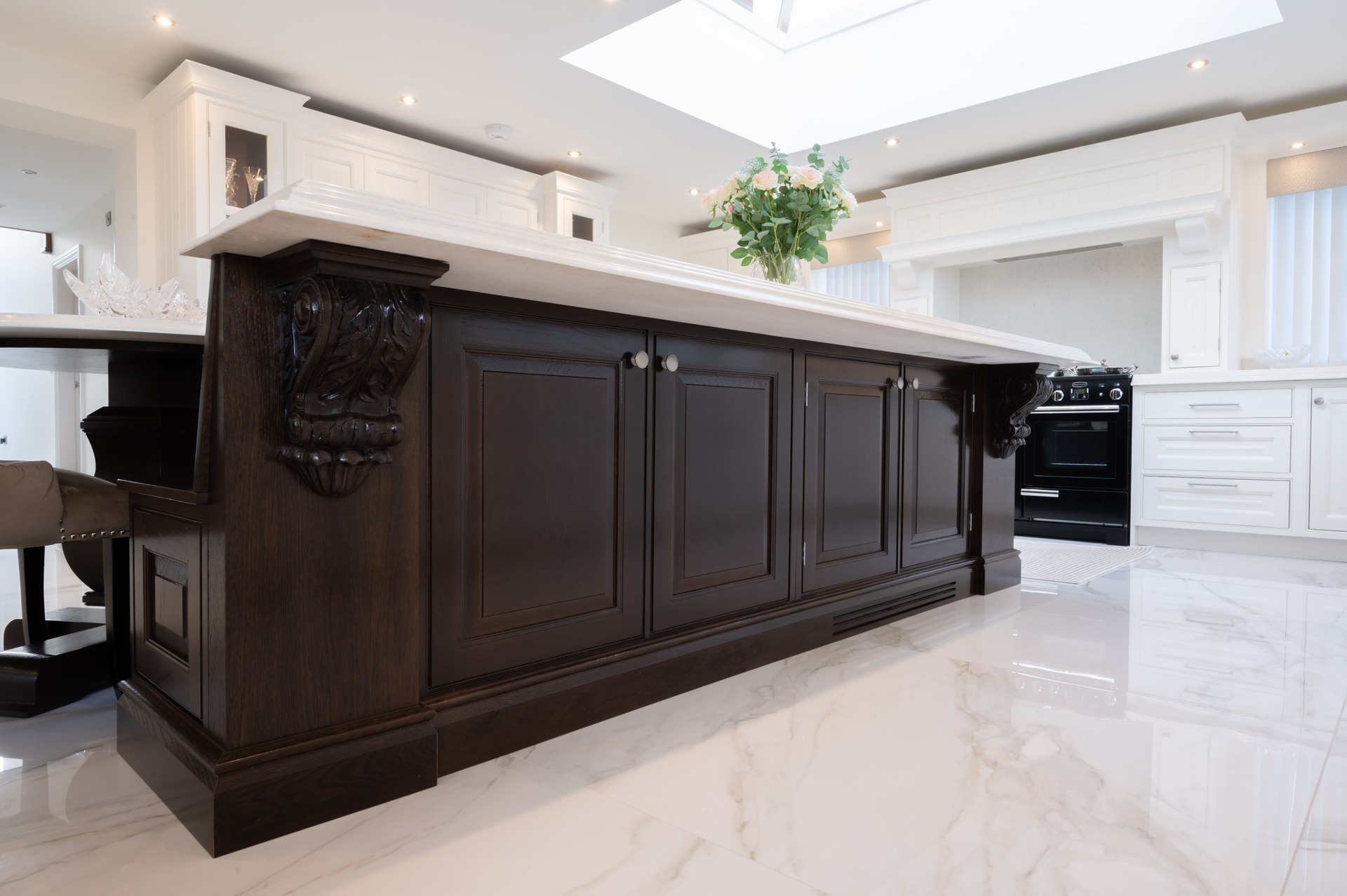
Cabinet dimensions, proportions, internal storage, mouldings, materials and finishes are all designed specifically for your project. Sloping ceilings, awkward corners, uneven floors and unusual room shapes can be incorporated into the design, instead of leaving you to work around standard components.
With genuine bespoke kitchen design, you also have much more control over the materials used. Solid timber, joinery details and finishes can be selected to suit the style of the kitchen as well as how you use it, instead of being limited to the options available within a manufacturer’s range.
At Holme Tree, our furniture is hand-crafted in our workshop in Ashby-de-la-Zouch. We’ve been designing and making kitchens for over 25 years, and everything we build is made to order for a specific home.
The three options side by side
| High street | Made to measure | Bespoke | |
| Personalisation | Choose from set styles, colours and handles | Range-based design, adapted to your dimensions | Designed entirely around your home and routines |
| Fit in awkward spaces | Gaps closed with filler panels | Better fit, within the limits of the range | Designed for the space as it is. Cabinets can be made to suit different shapes as well as sizes |
| Materials | Usually chipboard or MDF with foil or laminate finishes | Varies considerably by supplier | Selected for the project, including solid timber and a more personalised choice of materials |
| Where it’s made | Mass-produced or imported | Often a mix of stock and adapted components | Made to order, typically in the company’s own workshop |
| Design process | Largely self-led or in-store, often with online DIY software | In-store or at home, with some site measuring | In-depth personalised consultation, site visits and a design developed with you |
| Lead time | Shortest, often a few weeks | Usually somewhere in between | Longer, due to the detailed design process and made-to-order manufacturing time |
| Typical cost | Lowest upfront cost | Mid-range | Highest investment, reflecting premium materials, fully personalised design and bespoke craftsmanship |
| Installation | Frequently subcontracted or arranged by you | Varies | Often carried out by the company’s own fitting team |
| Longevity | Shorter lifespan, replacement more likely | Depends heavily on carcass and door quality | Built to last, with repairs and adjustments usually possible |
What affects your bespoke kitchen lead time
Many assume that bespoke kitchens have the longest lead times because the furniture is made from scratch, but it depends a great deal on who controls the manufacturing process.
When furniture is bought in from elsewhere, you’re working to someone else’s production schedule. If something arrives damaged or a door needs replacing, you have to wait for it to be made and shipped again, which can add weeks to a project that was otherwise on track.
At Holme Tree, we keep stocks of timber and make our furniture here, so we’re not waiting on replacement parts to be sent from elsewhere. The lead times we do plan around tend to come from items such as appliances and sinks, and we reduce the risk of delays as much as we can by ordering these well in advance.
Beyond that, the complexity of the design can affect the timing too, as can the work needed to prepare the space, and whether the kitchen is being fitted as part of an extension. Whichever route you choose, your designer should be able to give you a realistic idea of the timings from the beginning of the project.
Comparing quotations fairly
One of the difficulties at this stage is that two quotations can look similar on paper and cover very different things. One might include appliances, worktops, internal storage, delivery and installation, while another covers cabinetry alone.
Before you compare figures, make sure you’re comparing the same scope of work. Our guide to the 10 questions to ask before investing in a bespoke kitchen covers what a comprehensive quotation should include, along with the other questions worth asking early on.
So which one is right for you?
There’s no single right answer; the best choice depends on your home, your budget and your plans.
A high street kitchen can make sense if keeping costs down is a priority, your room is a regular shape or you’re unlikely to be in the property for a long time.
Made-to-measure is a useful middle ground if standard units don’t give you the fit you need, but you’re happy with the look and specification of a specific range.
A bespoke kitchen makes sense when you’re ready to invest in your forever home, your room has period features or quirks that standard units can’t accommodate or you want your kitchen crafted from a particular material such as hand-painted timber, walnut or oak. It is also the ideal choice when you want the design to work around the way you use your kitchen rather than having to compromise your ideas or adapt the way you live to suit a standard layout.
A kitchen designed around you
If you’re still weighing up your options, being able to open a drawer or see the joinery and finishes up close can give you a much better sense of whether they will suit your home than any photograph.
You’re very welcome to visit the Holme Tree showroom and workshop in Ashby-de-la-Zouch, where you can see examples of our work and talk through your project with our team. We’re here to answer any questions you may have.
Frequently Asked Questions
Are bespoke kitchens more expensive than high street kitchens?
The upfront cost is generally higher, and that reflects the design time, the quality of the materials and the craftsmanship involved. It’s worth looking at the cost over the lifetime of the kitchen as well. A well-made kitchen made from premium materials can be repaired, adjusted and refinished, whereas kitchens built from lower-grade components are more likely to need replacing.
Can a bespoke kitchen work in a small space?
Small and awkwardly shaped rooms are often where bespoke makes the biggest difference. When every cabinet is made to your dimensions, there’s no space lost to filler panels, and storage can be designed around exactly what you need.
How do I know if a kitchen company is genuinely bespoke?
Ask where the furniture is made, who makes it and what materials the furniture is made from. Companies that design and make in their own workshop can usually answer those questions immediately, and many will be happy to show you the workshop and their current projects in production.