
Few words in the furniture industry have been stretched quite as far as “bespoke”. It appears on high street showroom signage, in glossy brochures, and across the websites of companies whose entire product range comes in three standard widths. At some point, the word stopped meaning what it says.
This matters – not for pedantic reasons, but because the distinction between genuinely bespoke furniture and modular furniture with a premium finish affects what you can actually achieve in your home.
Where the Word Comes From
The term bespoke originates in traditional tailoring. A bespoke suit is cut specifically for the individual wearing it – not adapted from a pattern, not adjusted at the waist, but made from scratch around the measurements and requirements of one person. Nothing about it exists before that person commissions it.
Applied to furniture, the same principle should hold. Truly bespoke cabinetry is designed and manufactured specifically for a particular space and a particular client. The dimensions, the construction, the internal layout, the finish – none of it is pulled from a catalogue. It is conceived and built anew.
What “Bespoke” Has Come to Mean in Practice
What many companies mean when they use the word is something quite different. They offer a range of cabinet carcasses in a fixed set of sizes – typically in 100mm increments – which can be combined in various configurations. You choose a door style, a colour, and a layout from the available options. Fillers bridge the gaps between units and walls.
This is a modular system. It is a perfectly reasonable way to produce kitchens at scale, and at the higher end of this market the finishes are often excellent. But it is not bespoke. The furniture is adapted to your space; your space does not dictate the furniture.
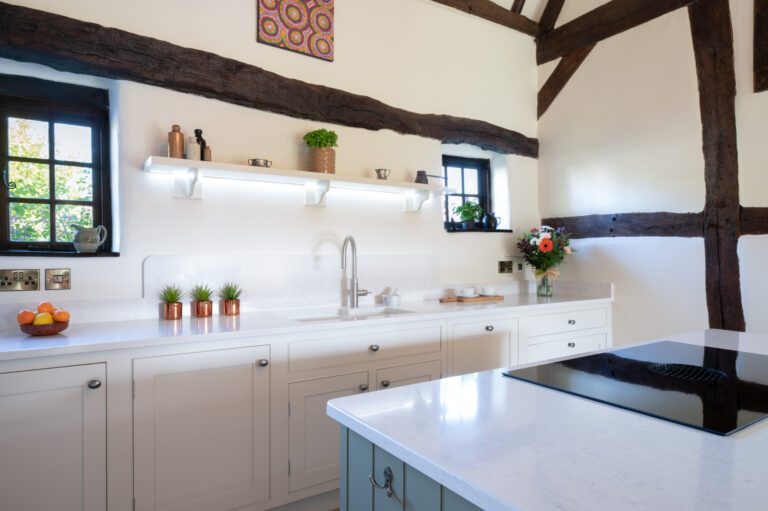
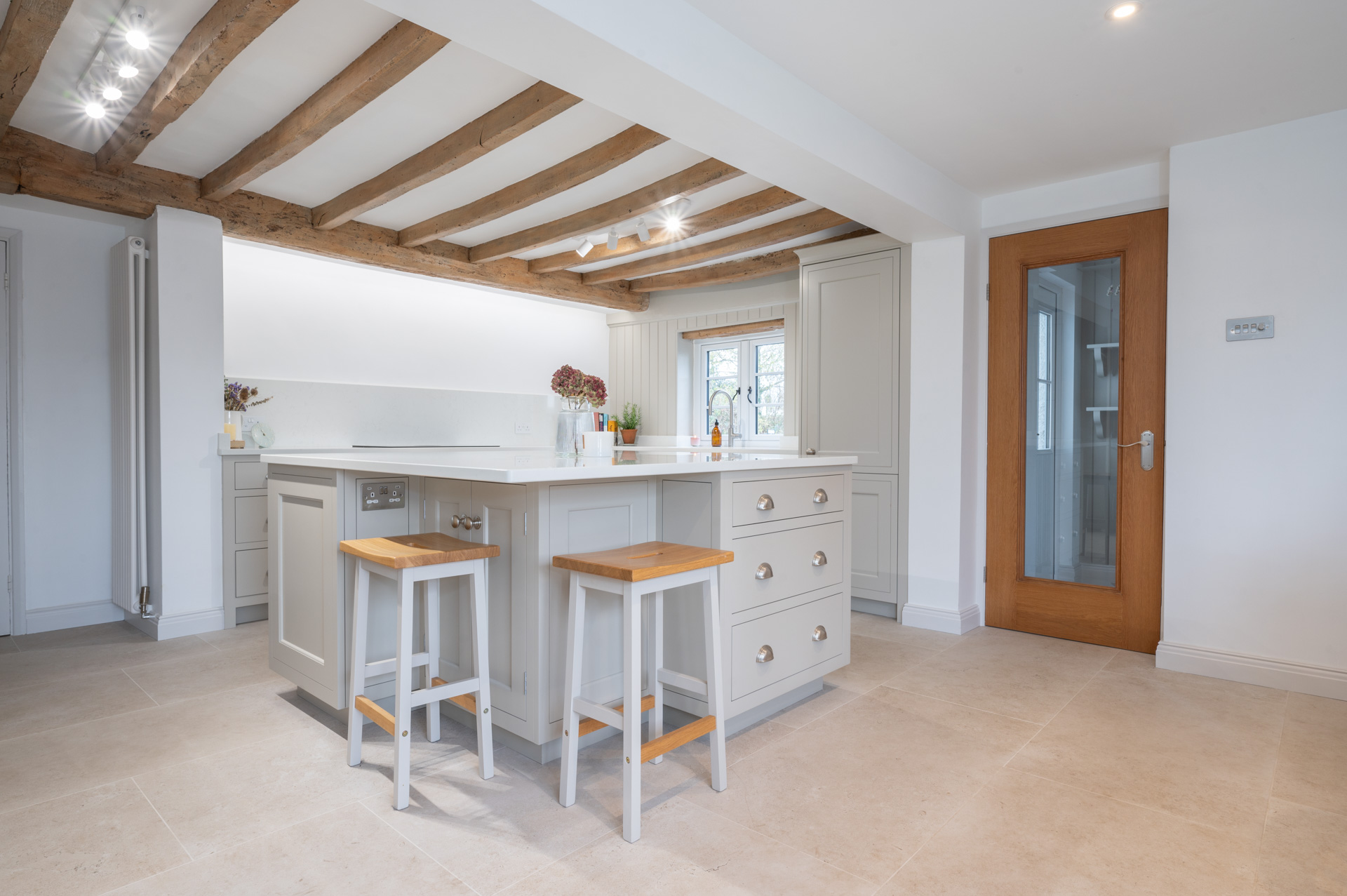
The difference is most visible in awkward or character-rich properties – period homes, extended houses, rooms with beams or sloping ceilings. In these spaces, the compromises of a modular system become apparent: visible gaps, filler panels that draw attention to themselves, layouts that work around the constraints of standard sizing rather than genuinely solving them.
How Genuinely Bespoke Furniture Is Made
At Holme Tree, the process starts with the space and the client, not a catalogue. Every project is individually designed and then individually manufactured in the workshop in Ashby de la Zouch.
Practically, this means:
- There is no standard cabinet size – dimensions are set by what the space and the design require
- Cabinets are rigid-built, not flat-packed, with solid backs and genuine structural integrity
- Doors are thicker than standard and CNC-finished to ensure they are perfectly square
- Oak dovetailed drawer boxes are produced in the workshop – not bought in
- Internal features – cutlery trays, spice racks, shelving – are made to the exact dimensions required
- Furniture is hand-painted on site, not sprayed in a factory and delivered
The machinery is configured fresh for each client’s project. A kitchen for a farmhouse in north Leicestershire requires different tolerances and different solutions than a kitchen for a contemporary extension in a market town. Both are made from scratch.
Why Construction Quality Matters as Much as Design
It is easy to focus on the visible elements of furniture – the door style, the colour, the handles. These are the things that photograph well and the things most people talk about when they describe what they want.
But the longevity of a kitchen is determined by what is behind the doors. Cabinet construction, drawer mechanism quality, the weight of the carcass, the way joints are formed – these are the details that determine whether a kitchen still looks and functions beautifully in fifteen or twenty years.
Holme Tree clients regularly return to the showroom years after their installation to share how pleased they remain with furniture installed a decade or more ago. Some commission new projects in new homes, wanting the same quality replicated. A few bring back elements of very old kitchens to be matched seamlessly into a new space. That is the practical definition of furniture built to last.
How to Tell the Difference When You Are Looking
If you are considering a kitchen or fitted furniture project and want to understand what you are actually being offered, a few questions cut through the language quickly:
- Can the cabinet dimensions be set to any size, or do they work within a standard increment system?
- Are the drawer boxes made in-house or bought in from a third-party supplier?
- Is the furniture rigid-built before delivery, or does it arrive flat-packed and assembled on site?
- Is the painting done in a factory or on site after installation?
- Does the company manufacture the furniture themselves, or do they design and then outsource production?
The answers reveal a great deal about what you are genuinely purchasing – and whether the word “bespoke” is being used in its proper sense.
If you would like to see genuinely handmade furniture and understand the construction detail for yourself, Holme Tree’s showroom and workshop are open for visits in Ashby de la Zouch. You can explore completed projects in the project gallery or book a design appointment to discuss your own home.
Frequently Asked Questions
Is all bespoke furniture handmade?
Not necessarily. Some companies use the terms interchangeably, but they are not the same thing. Bespoke refers to something made to individual specification; handmade refers to the method of manufacture. The best bespoke furniture is both – designed specifically for the client and made by skilled craftspeople rather than automated production lines.
How much does bespoke furniture cost compared to a modular kitchen?
Genuinely bespoke furniture from a company that designs and manufactures in-house will typically cost more than a high street modular kitchen, but is competitively priced against premium national brands. The comparison is most meaningful when you consider longevity – a well-made kitchen that lasts twenty-five years represents better value than a cheaper one replaced in ten.
Does bespoke furniture take longer to produce?
Yes, because it is made individually from scratch rather than assembled from pre-produced components. Lead times vary by company and project complexity. At Holme Tree, clients are given a clear installation programme at the point of quotation.
Can bespoke furniture work in a modern home as well as a period property?Absolutely. Bespoke construction is not inherently traditional in style – the design can be as contemporary as the client wants. The advantage of bespoke manufacture is precision fit and quality, both of which are relevant regardless of the architectural style of the home.
What is the difference between semi-bespoke and fully bespoke?
“Semi-bespoke” typically means a modular system with a wider range of size options and finishes than standard. It offers more flexibility than an off-the-shelf range, but is still constrained by the manufacturer’s production system. Fully bespoke means no pre-set dimensions – the furniture is designed and made around the space.